Tumbar estatuas was born from the political and poetic impact I felt after the toppling of statues of the conquistador Sebastián de Belalcázar by the Misak Indigenous community in Colombia, following the social uprising of 2020. It also stems from an interest in exploring rhythmic tools and relationships between spoken and instrumental discourse as ways of intervening in established narratives.
Beyond its political dimension, the piece is also an exploration of rhythmic material as a means of moving between the documentary and the musical. The snare drum, with its reconfigured traditional rudiments, serves as a starting point for investigating accents, patterns, and shifts between the spoken voice and the instrument.
Through the dialogue between snare drum and electronics, the work exposes and saturates fragments of journalistic and political speeches, revealing rhetorical mechanisms that tend to simplify or distort the complexity of certain events. Words like “vandal” are repeated, stretched, and fragmented until they lose their semantic charge and become rhythm, texture, insistence.
I aimed not to offer a one-sided reading. I wanted Tumbar estatuas to invite active, questioning listening. Rather than respond with an explicit counter-discourse, I propose tensions between language and sound, from dominant narrative to abstraction.
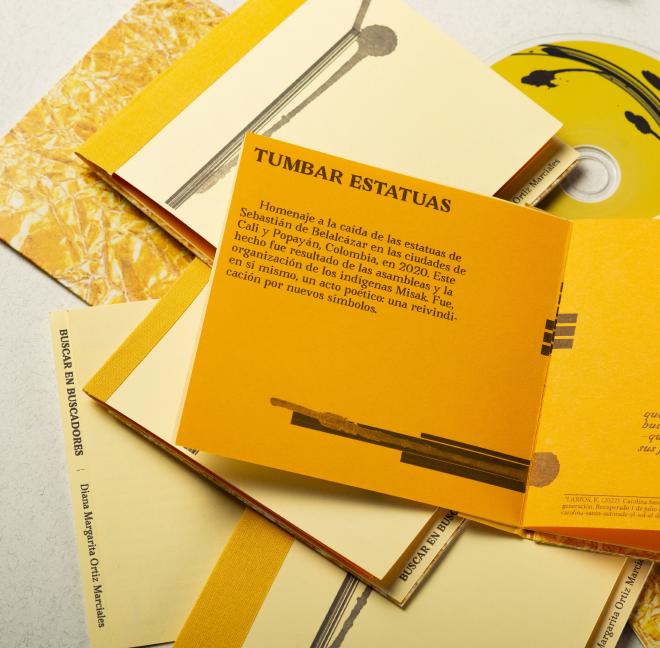
Deep thanks to the performers I collaborated with during the creation of this piece: Jhoan Infante and Wan-man Yen. Also to Chun-An Chuang for the performance recorded on the album Buscar en buscadores.
/Cover photo taken from the video of the soundcheck for the graduation recital "Buscar en buscadores" at the Folkwang Universität der Künste,captured by Marius Bajog, colored by Carlos Ortiz.