In Raspar un signo, the initial impulse was to work with cumbia samples as a starting point for exploring sonic textures. I’m drawn to this genre not only because of its timbral richness—where the accordion, güiro, and bass drum play a central role—but also because cumbia embodies a cultural fiction that reveals tensions in Latin American identity narratives. As noted by Juan Sebastián Ochoa y Carolina Santamaría, the term "cumbia" emerged in Colombia in the 1950s as part of a folklorist project that, while intending to spotlight music from the Caribbean—a previously marginalized region—ultimately simplified and homogenized a wide variety of musical expressions. Under this label, multiple rhythms and traditions were grouped together, erasing their differences to serve a functional notion of national identity.
Beyond Colombia, the continental spread of cumbia has also given rise to powerful appropriations. In Monterrey, Mexico, for example, marginalized communities transformed Colombian records by playing them at slower speeds, giving birth to cumbia rebajada, a sonic phenomenon that became central to the cultural identity of the kolombias—young people from working-class neighborhoods who reimagined cumbia through their own mode of listening.
My intention was to approach this music through sampling, but I found I couldn't integrate those materials coherently into my own language. I'm not interested in "stylizing" a living music or replicating melodies, so I prefer to distance myself from any idea of direct representation. Even so, certain ideas filtered into the piece: the friction between two bass drums, rhythmic elasticity, layering or homorhythm suggesting multiple tempos—all abstractly evoke gestures from cumbia rebajada. The güiro, in particular, became a central symbol in the piece: its oscillating, cutting character inspired several textures, both acoustic and electronic.
The electronics and certain harmonies are derived from spectral analysis of kick drum and low tom samples, from which I designed a multichannel synthesizer that produces spatialized resonances. Instrumentally, some textures explore imitation between voices to create emergent unisons, rather than independent lines.
In the final section, the piece centers around a large-scale homorhythm. Here, I wanted to explore two directions: on one hand, small grace notes that constantly shift the orchestration and displace the listener’s focus; on the other, rhythmic subdivisions that alter the perception of tempo, stretching and compressing it.
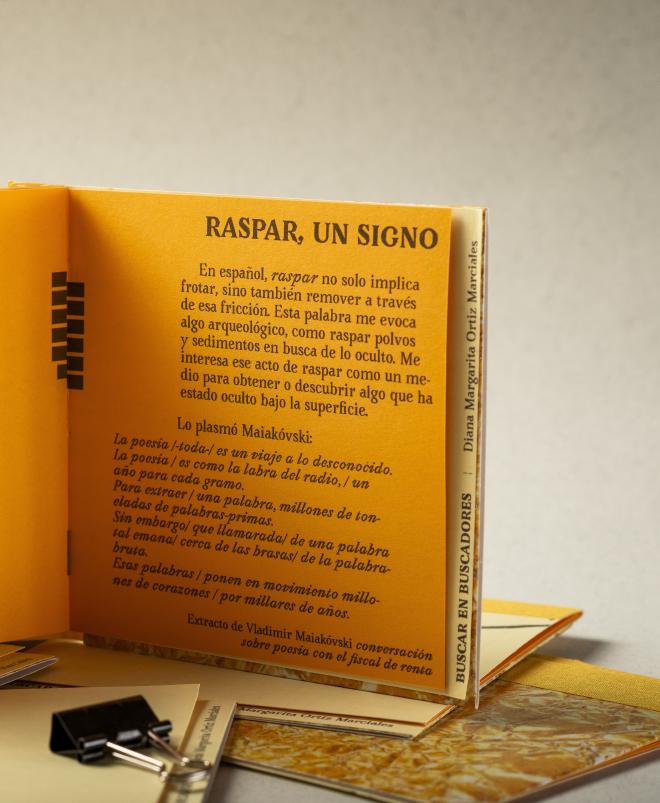
Cover photo taken from the video of the soundcheck for the graduation recital "Buscar en buscadores" at the Folkwang Universität der Künste,captured by Marius Bajog, colored by Carlos Ortiz.